
MSc in Nanoelectronics - current students
The Microelectronics and Nanostructures group in the School of Electrical and Electronic Engineering is offering a 12 month MSc course in Nanoelectronics, a field that merges semiconductor-based Nanotechnology with the need for ever smaller electronic devices.
This course gives a limited number (around 15) of highly qualified students the opportunity to learn firsthand about:
- state-of-the art organic and inorganic semiconductor nanostructures,
- the use of device fabrication techniques to produce nanoscale electronic components,
- modern experimental analytical techniques in characterisation of semiconductor materials and assessment of devices,
- the inner workings of real nanoscale devices such as Quantum Dot Lasers,
- and the latest computer modelling techniques of nanoscale structures and devices.

Overview
In the past forty years, the field of electronics has grown at an unprecedented rate. Silicon-integrated circuit technology has now developed to the point where complex VLSI systems containing billions of transistors can be constructed on a sliver of silicon only a few square centimetres in size.
However, the shrinking of transistor dimensions cannot continue indefinitely. Current predictions suggest that the scaling of traditional MOS transistors will reach a fundamental limit at around 20 nanometres, beyond which it will be necessary to find completely new technologies. Such technologies will form the basis for the electronic systems of the future.
Research is already under way into a range of technologies that are potential successors to the silicon era, although none has yet emerged as a clear winner in the race.
Collectively, these approaches come under the heading of Nanoelectronics, and it is this exciting new field which forms the subject of our new MSc programme.
This programme aims to:
- provide an advanced education in modern Organic and Inorganic Semiconductor engineering, emphasising the physical principles and their practical application;
- provide practical training into the different stages of the nanoelectronic component fabrication, from synthesis of raw materials to the processing and fabrication of the final device, experiencing all the different stages of assessment;
- and help students gain comprehensive theoretical and practical transferable knowledge in a rapidly expanding field through a carefully balanced mix of lectures, the use of modelling software packages and laboratory exercises.
Successful applicants will have the opportunity to:
- be taught by active researchers at the forefront of the field of Nanotechnology;
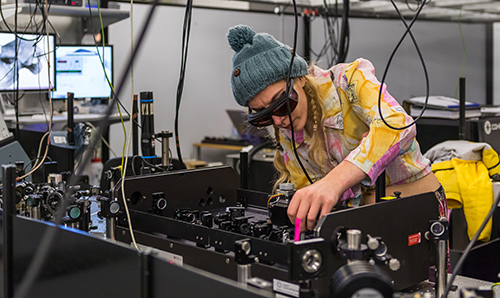
- make practical use of research equipment;
- perform projects within active research laboratories;
- and expand their career opportunities in both academia and industry.
Career Opportunities
Graduates from the Programme will find easy employment opportunities in:
- nano- and opto-electronics sectors,
- inorganic and organic semiconductor research and development centres,
- nanotechnology companies,
- scientific equipment manufacturing industries
- Asian economies (China, India, Korea, Taiwan, Singapore, Indonesia and Malaysia), where engineers with nanotechnology expertise play an important part,
- or postgraduate sesearch: every year we recruit an average of 7 PhD students to work on a variety of internationally recognised research projects.
Academic Entry Qualification
The standard academic entry requirements for a masters course will be an upper second class UK honours degree, or international equivalent, in an Engineering, Physics, Chemistry or Material Science discipline. A suitable background in solid state or semiconductor physics is highly preferable.
Continuing Professional Development (CPD)
Units on the MSc may be taken for Continuing Professional Development (CPD). Units will be delivered in 3 unit blocks to suit the needs of our industrial partners. For more information, please contact Professor Mohamed Missous.
Contact Us through Skype
Dr Max Migliorato, will be happy to talk to you about the course via Skype. If you have a Skype account and would like to set up a conversation with Dr Migliorato, please contact j.t.welsch@manchester.ac.uk for further details.
For more information about the course structure, lecturing team, and facilities, please click on the links on the left.